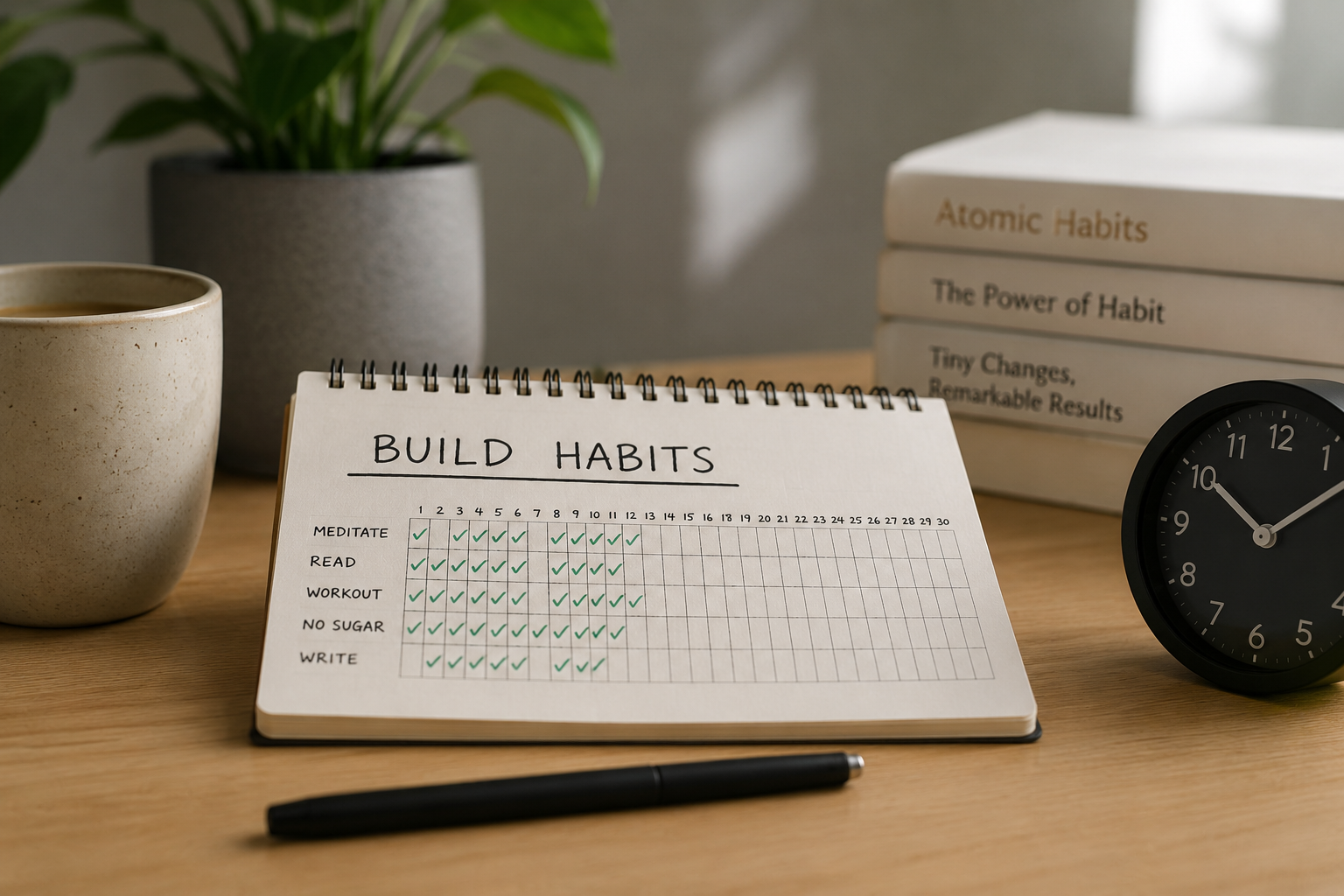
A 2024 systematic review and meta-analysis by Ben Singh, Andrew Murphy, Carol Maher, and Ashleigh Smith looked at how long health-related habits actually take to form. Across 20 studies and 2601 participants, the answer was not “three weeks.” Reported median timelines landed around 59 to 66 days, with individual ranges stretching from 4 to 335 days (Singh et al., 2024).
That is a much more useful frame for mind care.
The problem with the 21-day myth
The review explicitly pushes back on oversimplified habit timelines. Some behaviours become easier fairly quickly. Others take months. Some people settle into a routine fast; others need much longer. The important point is not the exact number. The point is that habit formation is variable, and short motivational sprints are a poor benchmark for whether a practice is “working.”
If you expect automaticity after 21 days, week three can feel like failure. If you expect habit strength to grow gradually over two to five months, the same week looks normal.
What actually seems to help
The review highlights a few recurring determinants of stronger habit formation: repetition, stable context, planning, self-selection, and in some cases morning practice. In plain English, habits grow more easily when the behaviour has a clear cue and happens in a repeatable part of daily life.
That matters for mind care because most people do not fail for lack of insight. They fail because the start point keeps moving.
A better question than “How motivated am I?”
Instead of asking whether you feel inspired today, ask:
What cue will start this behavior again tomorrow?
That is where the review becomes practical. If your practice begins after coffee, after lunch, after shutting down your laptop, or after brushing your teeth, you reduce the daily negotiation cost. The action does not need to be dramatic. It needs to be repeatable.
Why small often beats ambitious
The review also suggests that simpler, repetitive behaviours with clear cues can be easier to automate than more complex ones. That does not mean ambitious routines are bad. It means complexity raises friction.
For Braining Up users, that argues for a smaller entry point:
Pick one stable cue. Attach one short session to it. Repeat before you scale. That is less exciting than a total reset. It is also more realistic.
What this article is not saying
This is not a treatment plan, not a diagnosis pathway, and not a guarantee of any health outcome. It is a plain-language summary of habit formation evidence you can use to make daily cognitive practice easier to repeat.
A one-minute practice you can try today
Write one line on paper:
If I finish my morning coffee, then I open Braining Up for one short session.
That is all. One cue. One action. One repeatable start.
The better mind-care rule
Do not ask your routine to feel automatic by next week.
Ask whether the cue is stable enough to survive an ordinary Tuesday.
That is a better standard for mind care than hype or a fixed 21-day promise.
Sources
Singh, B., Murphy, A., Maher, C., & Smith, A. E. (2024). Time to Form a Habit: A Systematic Review and Meta-Analysis of Health Behaviour Habit Formation and Its Determinants. Healthcare. https://doi.org/10.3390/healthcare12232488