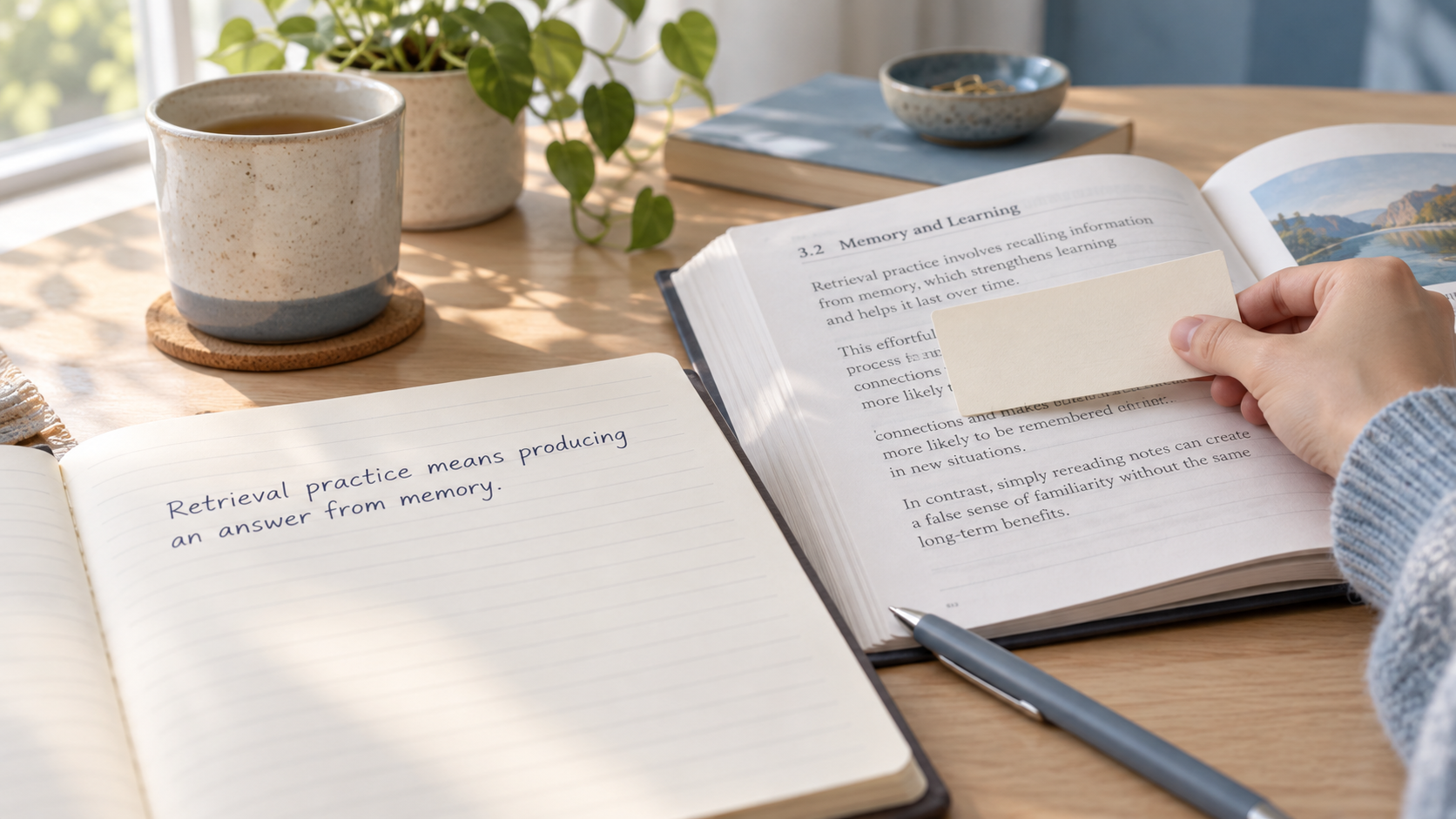
Most people practice the same way they reread.
They skim the notes. The ideas feel familiar. They nod and move on.
That silent nod is a kind of retrieval — researchers call it covert retrieval. You think the answer without saying or writing it.
There is another kind: overt retrieval. You produce the answer out loud or on the page.
A 2025 paper by Michelle Rivers, Paige Northern, and Sarah Tauber asked a practical question: when does the format matter?
What the study did
Students learned cognitive-psychology key terms and definitions. They practiced in three ways inside the same experiment: restudy, covert retrieval, and overt retrieval (typing the response). Two days later they took a criterion test.
That delay matters. Immediate fluency after rereading is easy to confuse with lasting learning.
What they found
When people practiced and later recalled definitions — multi-part, higher-demand material — overt retrieval consistently beat covert retrieval.
In Experiment 1, mean definition recall was about 0.50 after overt practice, 0.41 after covert practice, and 0.35 after restudy. Across experiments, the overt-versus-covert advantage for definitions was roughly g = 0.44–0.47.
For simpler key terms, overt still helped in several conditions, but the gap versus covert was smaller (about g = 0.32 when practice and test both targeted terms in Experiment 2).
Both retrieval formats often beat restudy when practice and test matched. That is the classic testing effect with an important twist: how you retrieve changes the size of the benefit.
Why silent recall can stop short
The authors frame this with a retrieval dynamics idea.
Retrieving one isolated term can feel automatic. Retrieving a full definition means pulling several connected pieces. When that happens silently, it is easier to stop early — to accept a sense of familiarity (“I know this”) instead of finishing every part.
Producing the answer changes the job. Speaking or writing creates accountability and makes missing pieces visible. Partial recall can cue the next piece. Incomplete silent recall can stay incomplete without you noticing.
The efficiency trade-off (the honest nuance)
Overt retrieval was not free.
When the researchers looked at gains per minute, covert retrieval was the more efficient strategy. Thinking the answer cost less time and still beat restudy in many matched conditions. Overt retrieval took longer and delivered higher absolute performance later.
So “best” depends on the goal:
Maximize what you can recall later → favor overt production for demanding material. Maximize learning per minute → covert can be a rational short practice, if you still attempt a full mental answer.
Another limit: practicing terms did not reliably transfer to recalling full definitions (and the reverse). Benefits were strongest when practice and later use matched.
What this means for daily mind care
If your “practice” is mostly rereading Slack threads, slide decks, or course notes until they feel familiar, you may be training recognition more than production.
A small upgrade:
Pick one short idea that matters today. Cover it. Say it or write it once — all the way through. Check what you missed. Stop. That is not a longer session. It is a more complete one.
Braining Up is built around short daily cognitive practice — the kind of window where a full attempt fits, then you leave. The point is not endless drilling. It is returning tomorrow with the same honest standard: produce the answer, do not only feel it.
If you want a short weekly note on mind-care practice (no fear hooks, no miracle timelines), join the email list. Or open Braining Up for one short session and treat the last minute as overt retrieval: finish the response, then stop.
Sources
Rivers, M. L., Northern, P. E., & Tauber, S. K. (2025). Does retrieval demand moderate the effectiveness of covert retrieval practice? Comparing covert and overt retrieval practice for learning key terms and definitions. Educational Psychology Review, 37, 61. https://doi.org/10.1007/s10648-025-10040-4