Why Active Recall Works Better Than Rereading
Before you scroll any further, pause for 15 seconds.
Without checking your phone, notes, or calendar, try to recall the last three things you ate today — in the order you ate them.
Ready?
This short task may seem simple, but it uses one of the best-studied mechanisms involved in learning and memory: actively retrieving information from memory.
What did your brain just do?
You were not given the answer. You did not read a list of your meals. You had to find information that was already stored in your memory.
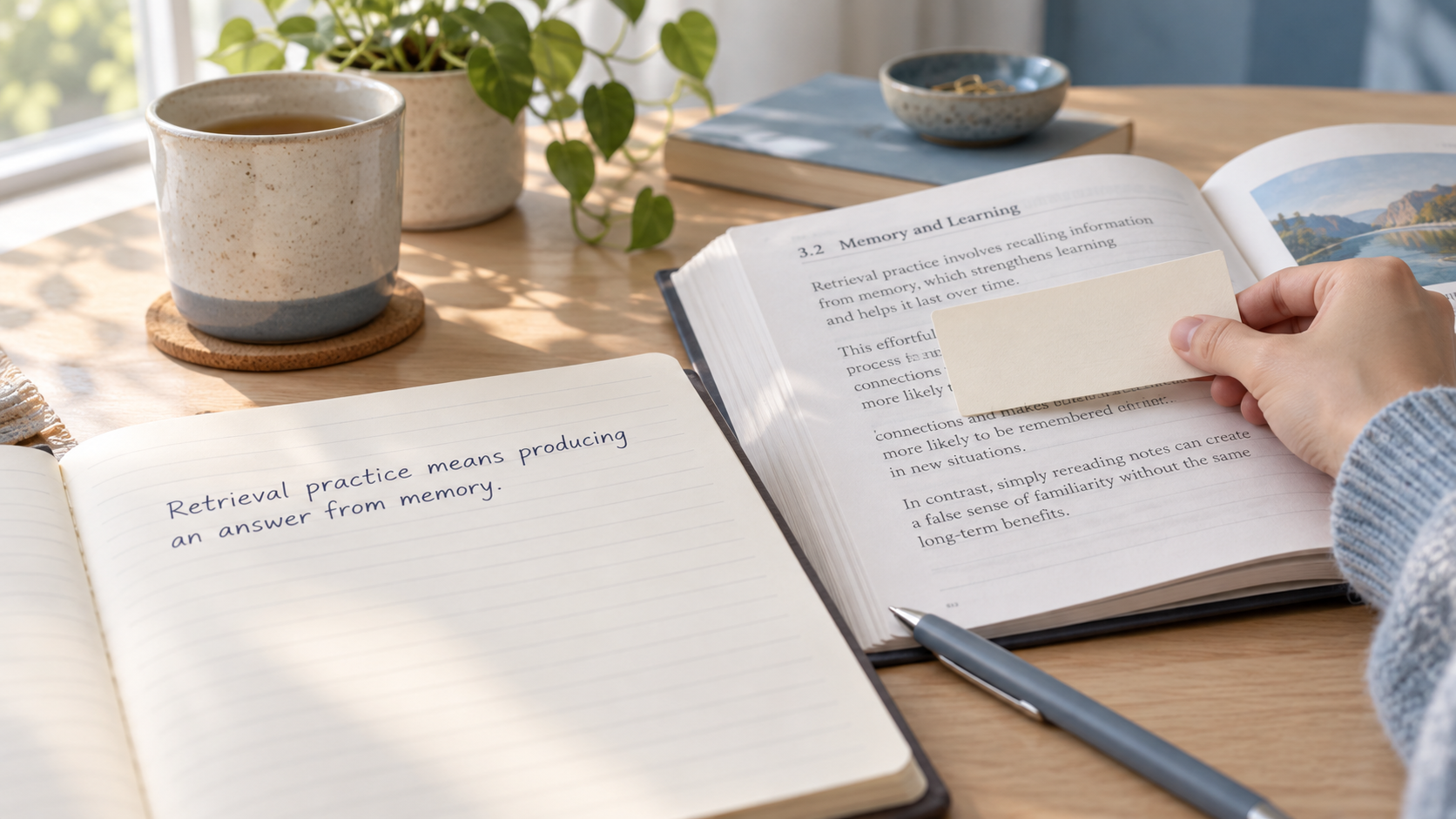
This process is called retrieval practice, also commonly known as active recall.
Actively pulling information out of your memory can strengthen its memory trace more than simply viewing or reading the same information again. That is why testing yourself often works better than rereading your notes.
Put simply:
- rereading helps you recognize information,
- active recall requires you to find it independently,
- each successful retrieval attempt can make the information easier to access later.
Why can rereading create a false sense of knowing?
When you read the same text for the second or third time, it begins to feel familiar. The sentences seem obvious, and the answers appear easy.
However, familiarity with the material does not always mean that you can recall it independently.
You may recognize the correct answer when you see it but struggle to produce it without a prompt. Only an attempt to retrieve the information independently shows what has actually remained in your memory.
That is why asking yourself a short question can be more valuable than passively reviewing the material again.
How can you use active recall in everyday life?
You do not need special tools or a long study session. Retrieval practice can be incorporated into ordinary situations throughout your day.
1. Recall events from your day
In the evening, try to recall three things that happened in the morning. Start with the first event and keep them in the correct order.
You can ask yourself:
- Who did I speak to today?
- What did I do immediately after breakfast?
- Which three tasks did I complete?
2. Close the book and summarize what you read
After reading a few pages, put the book down and answer this question in your own words: “What was the most important point in this section?”
You do not need to repeat the text perfectly. What matters is attempting to retrieve the main information independently.
3. Test yourself before rereading
Before returning to your notes, write down everything you remember about the topic. Only then compare your answer with the original material.
This makes it easier to notice which information is already accessible in your memory and which parts may need another review.
4. Recall details without prompts
Try to remember:
- your shopping list before opening the app,
- the route you followed during a recent walk,
- the names of people you met at an event,
- the order of your morning activities,
- the key points from your last conversation.
These short retrieval attempts can be performed throughout the day without setting aside additional time.
Does difficulty recalling something mean the exercise is not working?
No. A small amount of difficulty is a natural part of the task.
Retrieval practice does not require every answer to appear immediately. The effort involved in searching for information is an important part of the exercise.
When you cannot remember something, check the answer and then try to recall it again without help after a few minutes. Correcting yourself in this way can help you avoid reinforcing incorrect information.
The task should feel challenging, but it does not need to be frustrating. Start with short lists, simple events, and information you learned recently.
A small exercise to try now
Try one more brief retrieval attempt.
Without scrolling back up, answer these three questions:
- What is the mechanism described in this article called?
- How does active recall differ from rereading?
- How could you use this mechanism later today?
Only after answering should you return to the earlier sections and check what you were unable to recall.
This is how ordinary reading can become a more active way of working with your memory.
How do we use this mechanism in Braining Up?
At Braining Up, we focus on short, regular tasks that require active engagement. Instead of simply presenting information, the exercises encourage you to search for answers independently, identify relationships, and recall previously presented elements.
Each daily session includes tasks from different cognitive areas, such as memory, attention, logic, perception, and spatial thinking. The goal is not a single intense effort, but a regular practice that you can return to each day.
The most important thing to remember
When you want to remember something more effectively, do not limit yourself to reading the material again.
First, put the source aside and try to recall the answer independently. Only then check what you were able to retrieve.
Do not just review information. Try to pull it out of your memory.
Sources
- Pan, S.C. and colleagues — research on retrieval practice cited in a review published in Educational Psychology Review: Springer
- Review of research on retrieval practice and knowledge transfer: ScienceDirect